I just got a message from London that my application for a visa to Mongolia has been granted. Being the last one in the team to get this visa granted, this now means that all paperwork that is absolutely essential for our journey is done. There are still more visas and other paperwork that needs to be done, but nothing of that could derail the entire journey if it fails. This is how you spell relief!
Friday, May 25, 2012
Thursday, May 24, 2012
Vehicle Registration
Important news!
Our ambulance (Thomas insists we call her the HMS Dreadnought) is now properly registered with The Adventurists, approved by them to stay in Mongolia and they've confirmed that they've received the deposit we've paid to guarantee that we won't abandon it as scrap metal somewhere along the road if things would go really bad.
My good friend Fabian Wildenauer got us in touch with car mechanic Franz Lötscher (see previous blog post, Progress!) who did a careful examination of the ambulance, made a repair of a steering link (on his own expense, for the good cause! let that inspire you, too, to donate money) and wrote an assessment of the vehicle condition for the paperwork.
This means that we now are official participants in The Mongol Rally and that the most important piece of bureaucracy, that must be done before start, is done. One step closer!
To celebrate, we've ordered more pith helmets.
Sunday, May 13, 2012
Progress!
A few minutes ago, I got a text message telling me that my Mongolian visa got issued. This means I have my Uzbek, Tajik, Kyrgyz, and Mongolian visa, as well as Turkmen and Russian invites. I still need to get my visa for Azerbaijan and China, and, depending on how our plans in China turn out, for Kazakhstan and Russia.
I also got approval for two months of unpaid leave (a while ago, actually).
The last weeks were filled with rather unspectacular activities. We spent our time filling in visa forms, negotiating, and researching. We experienced a few setbacks: as we registered our ambulance with the organizers, we realized that by the rules, it is too old. And, after sending pictures as proof of it's good condition, the organizers asserted that it's not only too old, but also too rusty. We still think it's the best ambulance we can get, and even though we found another one that is in accordance with the rules, we believe our ambulance is superior and we will try very hard to make it work. Because none of us has the necessary skills, we set out to find a trustworthy mechanic. This mechanic needs to have the right adventurous attitude and the willingness to solve unusual problems. Finding this mechanic turned out to be more difficult than anticipated, but after some rather disheartening conversations ("I don't think we can do that"), we found Franz Lötscher from http://www.loetscher-ott.ch. He also thinks we're insane, but he will help us with our ambulance.
And then there is China. Driving through China is complicated (we expected that). We have a few offers from Chinese agencies to get the required permits, but right now we're stuck waiting for the other pieces of the puzzle to fall into place: we need to know our exact route including dates, and provide proof of hotel bookings and return flights. Right now, we still don't know whether we will be able to use the Altai border crossing, and we're still negotiating trying to avoid fixed dates.
I also got approval for two months of unpaid leave (a while ago, actually).
The last weeks were filled with rather unspectacular activities. We spent our time filling in visa forms, negotiating, and researching. We experienced a few setbacks: as we registered our ambulance with the organizers, we realized that by the rules, it is too old. And, after sending pictures as proof of it's good condition, the organizers asserted that it's not only too old, but also too rusty. We still think it's the best ambulance we can get, and even though we found another one that is in accordance with the rules, we believe our ambulance is superior and we will try very hard to make it work. Because none of us has the necessary skills, we set out to find a trustworthy mechanic. This mechanic needs to have the right adventurous attitude and the willingness to solve unusual problems. Finding this mechanic turned out to be more difficult than anticipated, but after some rather disheartening conversations ("I don't think we can do that"), we found Franz Lötscher from http://www.loetscher-ott.ch. He also thinks we're insane, but he will help us with our ambulance.
And then there is China. Driving through China is complicated (we expected that). We have a few offers from Chinese agencies to get the required permits, but right now we're stuck waiting for the other pieces of the puzzle to fall into place: we need to know our exact route including dates, and provide proof of hotel bookings and return flights. Right now, we still don't know whether we will be able to use the Altai border crossing, and we're still negotiating trying to avoid fixed dates.
Wednesday, March 21, 2012
The Right Equipment
As you might imagine, we are making feverish preparations for the great expedition. And as you might imagine, there are hundreds of things that need to be examined, prepared, applied for, bought, sold, collected, customized, written and translated. But there are certain things that are considerably more important than getting visas and permits. What could that possibly be I hear you ask. It is of course the trusty pith helmet.
The must have accessory of any would be adventurer for the last 300 years have always been and will always remain the trusted pith helmet.
The trusty pith helmet has been the headgear of choice for any adventurous man south of the alps since time immemorial. This essential piece of armour against the suns discolouring rays has been worn by distinguished adventurers like Lawrence of Arabia and Orde Wingate (when he could be forced to wear anything at all). It protects the bearer against all trials and tribulations one could possibly face anywhere in the world outside of the arctic. It leads an air of stoicism, panache, and adventurous spirit which is so sadly lacking in the world. And it's available on eBay.
Sunday, March 11, 2012
How do you make time?
This is my first blog post so please have mercy and indulgence me.
When you decide to something out of the
ordinary, questions will arise. Some of these questions are fun to
answer, like: “What route will you be taking?” Or something more
rhetorical: “Have you considered professional counselling?” But a
lot of people have asked the question: How do you have time to do
this?
And I understand why they might ask.
The team is well aware of that most people will never drive an
ambulance through Central Asia just for “fun” (and for charity).
And how do you make time for such an expedition? It’s simple, you
surround yourself with people who want to do something spectacular
and you make time. (Well, not really, but that sounded really nice.)
There are hundred of things you need to have figured out before you
embark on this trip. One of them are visas, an other is the car,
web page, blogging, permits, letters of invitations and finding a
safari suit with matching hat. These things take time. But the most
important thing, is to make a plan, ideally with a timetable and
stick to it. A couple of hours each week spent on research or
preparing for the trip will in the end add up. We spend hours in
front of computers, instead of just randomly searching the web, we
are using this great tool to further the expedition. The expedition
becomes a hobby, that takes time away from other things, but it’s a
question of priorities. And yes, 6 weeks locked in a car with two
other gentlemen of ill repute sounds like a long time (and it is).
However, instead of spending my holiday doing nothing, I thought I
might do something. This something is an adventure of a lifetime and
might make the people back home more interested in a part of the
world that seems forgotten and we might just raise some money for
charity.
How do get the time; we make time!
Just make up your mind and sign up. :)
Monday, March 5, 2012
£1,000
The Mongol Rally rules stipulate that every participating team must convince their fans, friends and family to donate at least £1,000 to an officially sanctioned charity. As of yesterday, we've now collected £1,050 in name of Ambulance To Mongolia for the Lotus Children's Centre Charitable Trust in Mongolia, which helps orphaned, abused, and abandoned children in Mongolia.
Just exceeding the minimal stipulated limit is however far from our ambitions, so please continue to donate even more money to this good cause:
http://www.mongolia.to/donate
Just exceeding the minimal stipulated limit is however far from our ambitions, so please continue to donate even more money to this good cause:
http://www.mongolia.to/donate
Tuesday, February 28, 2012
The Ambulance
How much do you know about ambulances? The past few months have made me first realize how precious little I knew about them, and then (after promising my team mates that I'll get us the ambulance) to learn more about them than I ever thought I'd do …
The first question was: If we want to give an ambulance to a hospital in Mongolia, where do we get it from? It turns out that ambulances really aren't any different from any other light commercial vehicles, and are sold and bought just like for example pickup trucks or vans. So I started browsing second hand vehicle web sites to learn what was available on the market, but the more ambulances for sale I found, the less I knew which one to buy.
The next question then became: When there are so many different kinds of ambulances out there, which kind do we really want? I had no idea. But by pure coincidence, I then got to know that an acquaintance of mine, Peter Wärnberg, happened to have worked as an ambulance driver for ten years, so I wrote him a long mail explaining what we were trying to do and asking for his help and advice to choose an appropriate vehicle.
Peter was happy to help and answer my questions. As a one time owner of a close-to-indestructible Volvo 740, I had been looking especially at Volvo ambulances and he could confirm this to be a good idea. So last Friday, I finally found an ambulance for sale that was what I now knew to be what we wanted and for which Peter found the listing to look good and believed it to be a vehicle in which we would be able to reach Mongolia.
So we in team Ambulance To Mongolia are now the proud owners of this beauty:
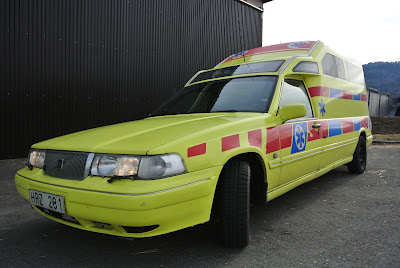
The Volvo 965 ambulance is supposedly one of few ambulances on the market that was purpose-built as an ambulance directly at the factory and has a chassis especially constructed for this. (We hope that this makes it sturdier than vehicles that were converted to ambulances, after leaving the factory as normal cars and vans.) It is equipped with the Volvo Modular engine B6304S, which was developed in a cooperation project with Porsche / Weissach and produces 204 hp to make the 5.7 m long and 2,680 kg heavy vehicle move swiftly. The automatic transmission is supposedly also not the same that was used in normal passenger cars but a custom version made for the ambulance, somehow made tougher and more reliable. Our ambulance was built in 1998, making it one of the last cars ever built of the safe and exceptionally reliable and repairable Volvo 900/700 series.
The first question was: If we want to give an ambulance to a hospital in Mongolia, where do we get it from? It turns out that ambulances really aren't any different from any other light commercial vehicles, and are sold and bought just like for example pickup trucks or vans. So I started browsing second hand vehicle web sites to learn what was available on the market, but the more ambulances for sale I found, the less I knew which one to buy.
The next question then became: When there are so many different kinds of ambulances out there, which kind do we really want? I had no idea. But by pure coincidence, I then got to know that an acquaintance of mine, Peter Wärnberg, happened to have worked as an ambulance driver for ten years, so I wrote him a long mail explaining what we were trying to do and asking for his help and advice to choose an appropriate vehicle.
Peter was happy to help and answer my questions. As a one time owner of a close-to-indestructible Volvo 740, I had been looking especially at Volvo ambulances and he could confirm this to be a good idea. So last Friday, I finally found an ambulance for sale that was what I now knew to be what we wanted and for which Peter found the listing to look good and believed it to be a vehicle in which we would be able to reach Mongolia.
So we in team Ambulance To Mongolia are now the proud owners of this beauty:
| Thomas insists we name her HMS Dreadnought. |
The Volvo 965 ambulance is supposedly one of few ambulances on the market that was purpose-built as an ambulance directly at the factory and has a chassis especially constructed for this. (We hope that this makes it sturdier than vehicles that were converted to ambulances, after leaving the factory as normal cars and vans.) It is equipped with the Volvo Modular engine B6304S, which was developed in a cooperation project with Porsche / Weissach and produces 204 hp to make the 5.7 m long and 2,680 kg heavy vehicle move swiftly. The automatic transmission is supposedly also not the same that was used in normal passenger cars but a custom version made for the ambulance, somehow made tougher and more reliable. Our ambulance was built in 1998, making it one of the last cars ever built of the safe and exceptionally reliable and repairable Volvo 900/700 series.
Subscribe to:
Posts (Atom)
